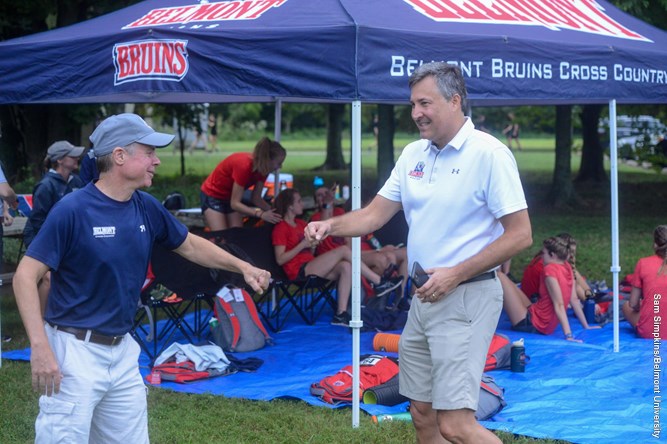
As Belmont University celebrates the 50th year of its cross country program, longtime coach Jeff Langdon reflects on the humble beginnings, defining moments and relationships that have shaped his life and the program he helped build from scratch.
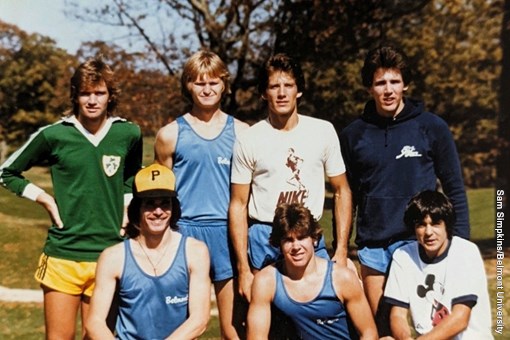
In an old photograph of Belmont University’s 1979 cross country team – the first recruiting class in program history – Jeff Langdon sits among a group of young runners wearing Dolphin jerseys, unaware of just how much the program would grow in the decades ahead.
At the time, Langdon was simply a college student who wanted to run. He had no idea he was helping lay the foundation for a program that would become a significant part of Belmont’s athletic history, which as a department, is celebrating 75 years.
Nearly 50 years later, Langdon serves as the program’s Director of Cross Country and Track and Field. His journey from student-athlete to longtime coach offers a perspective few people can share; he has experienced the program as both a young runner helping it get started and a mentor guiding generations of athletes.
For Langdon, however, the story has never been just about top performances, winning championships or building a successful athletic program. It has also been about faith, personal growth and the relationships that endure long after an athlete leaves campus.
A Program Begins with One Runner
The origins of Belmont cross country can be traced to 1976, when Mark Dennis arrived at the university on a basketball scholarship. According to Langdon, Dennis soon realized he would rather compete in cross country and track.
Dennis approached Dave Young, an admissions counselor who had helped recruit him, and asked for assistance in pursing those sports. Young helped get the program started, initially with very few athletes.
For the first few years, cross country at Belmont was a small operation. Dennis was largely on his own before other students, including a few tennis players, joined the effort. The program gradually expanded, and in 1979, Belmont welcome its first true recruiting class.
Langdon was among those runners.
Originally from the Hamilton, Ohio, area, Langdon had hoped to compete for the University of Cincinnati, where his father had attended college. When that opportunity did not materialize, Coach Young reached out with an invitation to help build something new at Belmont.
“We’ve got a good thing going here. We’d love for you to get this thing started,” Langdon recalled Young telling him.
Langdon accepted the opportunity, and the rest became part of Belmont history.
At the time, he did not think of himself as a program pioneer. He simply visited the college, met some of the other runners and discovered a place where he wanted to be.
“We definitely weren’t thinking about laying a foundation,” Langdon said. “We just, you know, visited the university, or actually college at the time, and met a few of the other guys, and was like, ‘This was a great place.’”
What began as an opportunity to continue running in college became a lifelong connection for Langdon.
Humble Beginnings and Lessons Along the Way
The early days of Belmont cross country were not always glamorous. Resources were limited, the team was small, and the athletes were learning as they went.
Langdon remembers one of his earliest experiences with the program: a nighttime run with teammates and local runners before official practices had even begun.
The group headed out around 9 p.m. During the run, the runners reached a turn, and Langdon followed the group in front of him. He continued running, believing he was on the right route, but soon became separated from everyone else.
What he thought would be a routine run turned into a much longer adventure. After covering approximately 14 miles, Langdon finally returned to the dormitory, about an hour and a half after the others.
His teammates were waiting—and laughing.
It was an unconventional introduction to college running, but it became one of the many memories that would define his experience at Belmont.
The program’s challenges extended beyond training routes. Financial support was scarce, and scholarships were not a major part of the early experience.
Langdon recalled that the team’s travel budget in 1979 was approximately $500. It took seven to eight years for the program to develop what he considered a legitimate budget.
Those early runners were not competing for the benefits available to many college athletes today. They were building a program largely from scratch, driven by their commitment to the sport.
Over time, Belmont cross country grew from a small group of runners into a much larger athletic operation.
 Growth Without Losing Identity
One of the most significant changes Langdon has witnessed is the size and scope of the program.
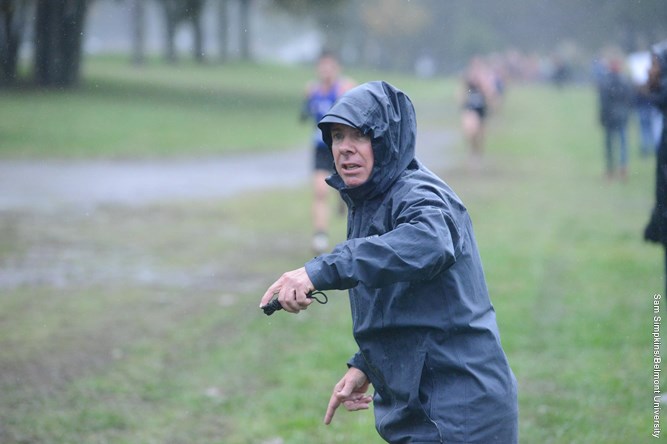
When he competed and later began coaching, Belmont primarily focused on cross country, with perhaps eight to 12 male and female athletes combined. Today, the university's cross-country and track and field program includes approximately 65 athletes across both genders and multiple event groups.
The growth has brought new responsibilities, but Langdon also sees it as an important development for the university.
Despite the changes, he believes one principle has remained consistent: the character of the athletes Belmont recruits.
As a Christian university, Belmont emphasizes personal responsibility, discipline, academic success, and a strong team culture. Langdon said the athletes who join the program generally understand those expectations and are encouraged to grow in their faith.
Every recruiting class brings different personalities and abilities, but he hopes they share a commitment to making good decisions and doing things the right way.
That consistency, he believes, has helped the program grow without losing its identity.
The results have also reflected the program's development. In 2023, Belmont's women's cross-country team won the university's first Missouri Valley Conference championship in the sport.
Langdon remembers the achievement as a special moment made possible by a group of women who bonded well as a team.
“It was just awesome,” he said. “Just to bring home that first championship for the university.”
For a program that began with a handful of runners, the championship represented a milestone in its evolution.
 More Than a Coaching Career
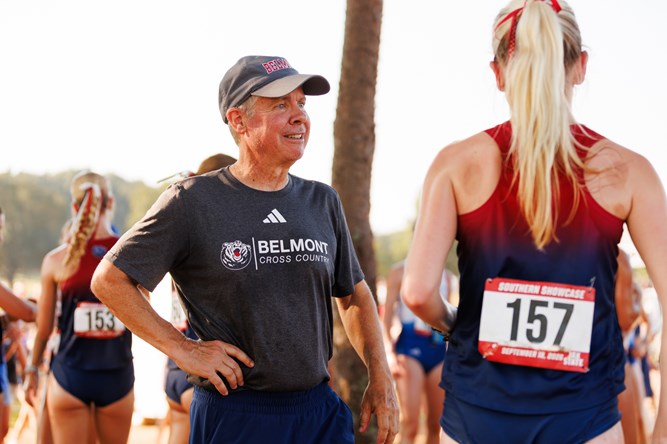
While championships and program growth are important markers of success, Langdon measures Belmont's influence on his life in more personal terms.
He credits the university with helping shape his faith and character.
“You know, that's where I became a believer in Jesus Christ, and so it holds a special place in my heart for that,” Langdon said.
His experiences at Belmont helped him develop both personally and professionally. He also points to the athletic department's culture and the support of university administrators as important influences throughout his career.
That sense of belonging has extended into his coaching philosophy.
When asked what kind of legacy he hopes to leave, Langdon did not focus on the number of championships he has won or records the program might hold. Instead, he described the importance of being a faithful, caring coach and mentor to the young men and women who have come through the program.
He hopes his former athletes will continue to see him as a friend, even after graduation.
For Langdon, one of the most meaningful signs of a lasting relationship is when former athletes return to campus to have lunch or coffee and reconnect.
He is grateful for the hundreds of athletes he has coached and recognizes that the relationships have shaped him just as much as he has influenced them.
“They've molded me maybe as much as I've molded them,” he said.
That perspective reflects a broader lesson about coaching: success is not limited to what athletes accomplish during their college careers. It also includes the people they become and the connections that continue long after competition ends.
Looking Back and Moving Forward
As Belmont concludes its 50th cross country season at the MVC Championships in Des Moines, Iowa, next week, Langdon acknowledges that the program’s history deserves greater attention.
He admitted that he has not always done enough to share the stories of the athletes and coaches who helped establish the program. He hopes to do more to ensure today's runners understand where they came from and appreciate the opportunities they have.
The contrast between the early years and the present is striking. The program that once operated with a travel budget of about $500 now supports dozens of athletes across cross country and track and field. Its history includes decades of development and a conference championship that brought new recognition to Belmont athletics.
Yet for Langdon, the most important part of that history may not be measured in numbers.
It is found in the people who showed up, trained together, supported one another, and helped create a community that lasted beyond their time as student-athletes.
After nearly five decades connected to Belmont, Langdon still has a sense of humor about the challenges of coaching today's 18- to 22-year-olds. He jokes about trying to keep up with their music and the language they use.
But when asked what advice he would give his younger self, his answer was simple.
“Don't take life so seriously. Focus on relationship over achievement.”
The advice is fitting for someone whose life has been shaped by a program that grew from a small group of runners into a lasting part of Belmont's identity.
As the university celebrates 50 years of cross country, Langdon's story serves as a reminder that legacies are not built in a single season. They are created over time, through shared experiences, commitment, and relationships that continue long after the final race.
For Langdon, the real measure of success is not simply how far Belmont cross country has come, but the people who have helped carry it forward.